
Why You Can't Hire Your Way Out of a Broken Process
Every growing business hits the same wall. The informal systems that worked when there were five people start to buckle at 15. By the time you reach 25 or 30, the cracks are structural. Scaling a business without chaos isn't about working harder or hiring faster. It is about building the operational infrastructure that lets you grow without proportional increases in stress, confusion, and firefighting.
Most founders experience this as a feeling: something that used to be easy now takes three times as long. Information that everyone once shared naturally now lives in separate heads, separate tools, separate email threads. The business is growing, but so is the friction.
This is the coordination problem. It has a mathematical basis that explains why growth feels harder than it should, and a set of practical frameworks for addressing it at each stage.
Why Scaling Business Operations Breaks Down
The difficulty of coordination doesn't increase linearly with headcount. It increases quadratically. The formula for communication lines in a team is n(n-1)/2, where n is the number of people.
A team of three has three communication channels. A team of 10 has 45. A team of 15 has 105. A team of 25 has 300.
This is not abstract mathematics. It is the reason your Monday morning feels different at 20 people than it did at eight. More messages. More meetings. More "just checking in" interruptions. More decisions waiting on information that someone has but nobody can find quickly.
| Team size | Communication lines | Typical coordination approach |
|---|---|---|
| 3 people | 3 | Direct conversation works fine |
| 7 people | 21 | Weekly meetings start appearing |
| 15 people | 105 | Meetings multiply; things start slipping |
| 25 people | 300 | Departments form; silos emerge |
| 50 people | 1,225 | Formal processes or organisational debt |
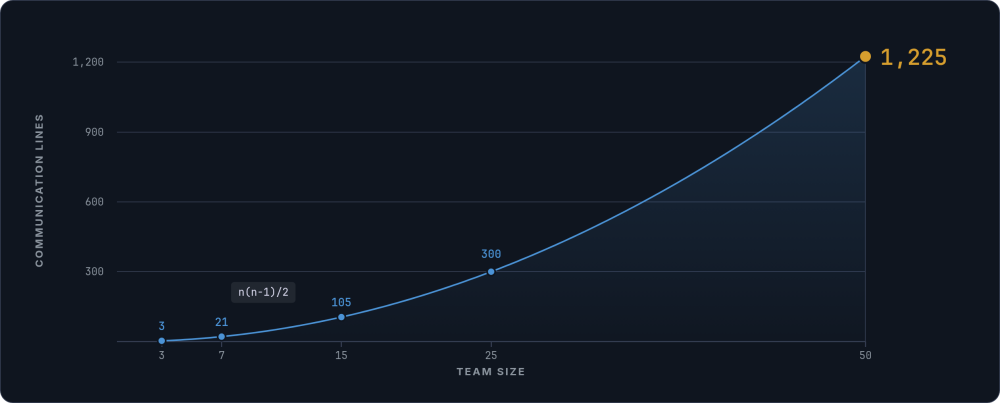
The founder's instinct at this point is to manage harder: more check-ins, more oversight, more personal involvement. This works briefly and then makes things worse. The founder becomes the bottleneck, and the business cannot move faster than one person's capacity to stay across everything.
Nobody budgets for the resulting chaos. There is no line item for "time spent searching for information" or "rework caused by miscommunication." But the costs are real and consistent across growing businesses of all kinds.
The Hidden Costs of Operating Without Systems
Research on knowledge worker productivity consistently shows that information fragmentation is one of the largest drains on a growing organisation. The following patterns are typical of UK service businesses in the 10 to 50 employee range.
| Area | Without systems | With systems |
|---|---|---|
| Time finding information | Typically 2 to 3 hours per person per week | Under 15 minutes per week |
| Rework from miscommunication | 10 to 15% of deliverables | Under 2% |
| Client response time | 24-48 hours | Within hours |
| Onboarding new staff | 3-6 months to full productivity | 4-8 weeks |
| Revenue leakage | 5 to 8% unbilled or undercharged work | Under 0.5% |
For a service business turning over £2 million, these gaps can represent something in the region of £200,000 to £300,000 in annual value lost to friction, duplication, and things falling through cracks. The worst part is that these costs scale with the business. Every new hire adds to the coordination overhead, and every new client adds to the information management burden.
If the symptoms sound familiar, your business may already be showing signs of outgrowing its current setup.
Find your stage. If you have 10 to 18 staff and the friction is growing, start with project visibility and a single source of truth for client data. If you are closer to 25 and departments are forming, focus on handoff processes and cross-departmental reporting first.
Fix the Process Before You Hire Into It
The natural response to growing pains is to hire. More hands, less pressure. But Fred Brooks observed in The Mythical Man-Month that adding people to a late project makes it later. The same principle applies to business operations more broadly: adding people to a broken process doesn't fix the process. It scales the breakage.
Each new hire adds n-1 communication lines to the team. They consume the attention of existing staff who are already stretched. And they generate questions that wouldn't exist if the process were documented.
Work through a concrete case. A business with 15 people hires number 16. That single hire adds 15 new communication lines. The new person needs onboarding attention from existing staff. They encounter undocumented processes and start asking "where do I find" questions that pull colleagues away from productive work. If the process they're hired into is already inconsistent, they learn a version of it from whoever happens to train them, introducing yet another variation.
Scaling business operations requires sequencing. Fix the process first. Document it. Build the system that supports it. Then hire into a structure that lets new people become productive quickly rather than adding to the noise. A business with clear processes and centralised knowledge turns a new hire into a productive team member in weeks. A business without them turns a new hire into another person asking "where do I find...?"
The most important principle in scaling without chaos is to invest in operational systems slightly ahead of the need. Not years ahead. Not enterprise-grade platforms for a 12-person team. But one stage ahead of where you are now.
| When to build | The system | Before you need it for |
|---|---|---|
| 5 people | Document your core processes | Ensuring consistency as you add people |
| 10 people | Centralise client and project information | Anyone serving any client without handholding |
| 15 people | Define handoff rules and ownership | Work moving between people without losing context |
| 20 people | Automate handoffs and status updates | Consistent delivery without supervision |
| 35 people | Build cross-departmental visibility | Decisions from shared data, not departmental assumptions |
The cost of building systems proactively is always lower than the cost of fixing the problems that accumulate when you wait. A process that is still consistent across the team is far cheaper to document and encode than one that has already fragmented into 15 individual variations.
Operational Health Diagnostic
If you are not sure whether your business has outgrown its current approach, these signals are a reliable diagnostic. Most growing businesses will recognise items from both columns. The balance between them tells you how urgently you need to act.
Signs of chaos
Signs of structure
The systems-first mindset: Systemising your business is not about removing people from the equation. It is about removing friction from their work. The system does not forget, does not take holidays, and does not need three months to get up to speed.
Four Stages of Operational Scaling
A 10-person team running on email and spreadsheets faces entirely different problems from a 40-person company with emerging departments. Businesses pass through distinct stages, each with characteristic pain points and each requiring different operational responses. Understanding where your business sits helps you invest in the right systems at the right time.
Stage one: the founder's reach (1 to 10 people)
At this stage, the founder sees everything. Communication is direct. Decisions are fast. Quality is maintained through personal oversight. The tools are simple: email, a shared drive, perhaps a project management tool, and a spreadsheet or two.
What works: Direct oversight, informal communication, flat structure, the founder as quality control.
What to build now: Document your three to five core processes. Not elaborate manuals. Simple write-ups of how the most common tasks are done, so that the next person you hire can follow them without shadowing you for a month.
The danger: Not the approach itself, but the assumption that it will keep working. Founders who recognise this stage as temporary and start building systems before they need them navigate the next stage far more smoothly.
Stage two: the coordination crisis (10 to 25 people)
The founder can no longer see everything directly. Information becomes asymmetric: different people know different things, and nobody has the full picture. Status meetings multiply. Work gets duplicated. Client details scatter across personal notebooks, email threads, and spreadsheets.
What breaks: Handoffs between people. Sales promises one thing, delivery receives a partial version. Client history is spread across three inboxes. The founder spends more time coordinating than doing actual work.
What to build now: A single system of record for client and project data. Defined handoff processes between roles. Shared visibility into project status that does not require chasing updates.
The danger: Trying to solve coordination problems by adding more meetings. Meetings are a symptom of missing systems, not a cure for them.
Stage three: the departmental divide (25 to 50 people)
Departments form. Sales, delivery, operations, finance. Each develops its own tools, its own language, and its own version of the truth. Data silos emerge not from deliberate choices but from organic growth in different directions.
What breaks: Cross-departmental handoffs. Sales closes a deal, but delivery's view of the scope differs from the proposal. Finance cannot reconcile project costs because the data lives in three different systems. Reporting requires manual assembly from multiple sources.
What to build now: Connected systems that share data across departments. A single source of truth for client, project, and financial data. Automated triggers that move work between teams without manual handoffs.
The danger: Each department optimising its own tools in isolation. Local optimisation creates global fragmentation. The business needs integration, not more departmental tools.
Stage four: the governance gap (50 to 100 people)
At this scale, accountability diffuses. It becomes genuinely difficult to ensure that everyone follows the same standards, uses the same processes, and maintains the same quality. Consistency requires governance, and governance requires systems.
What breaks: Consistency. Two teams handling similar work develop different approaches. Quality varies depending on which team or individual handles a piece of work. Compliance and audit requirements become harder to meet because processes are not standardised.
What to build now: Governance frameworks with role-based access. Standardised processes enforced by systems rather than by management oversight. Data-driven capacity planning. Automated compliance checks.
The danger: Retrofitting systems into a 70-person organisation is significantly harder and more expensive than building them into a 20-person one. The cost of delayed action compounds with every new hire and every new workaround that becomes embedded.
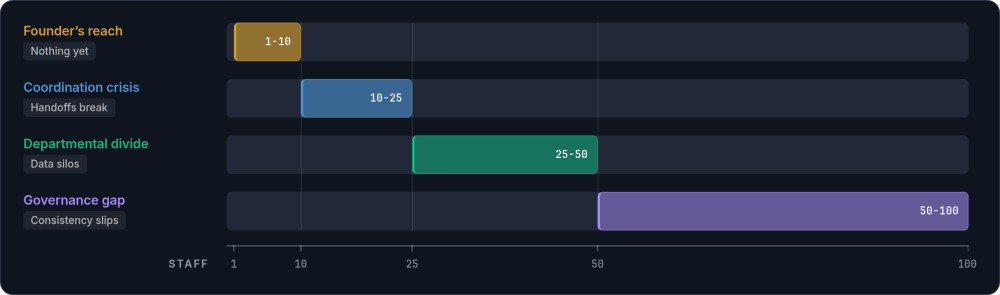
At each stage, what "good" looks like is a capability stack, not a specific product. At 15 people: centralised client records, documented handoff processes, a shared view of project status. At 25: automated invoicing triggers, process automation for repeatable tasks, cross-team visibility. At 50: governance frameworks, role-based access, data-driven capacity planning.
The specific tools matter less than whether the capabilities exist. What you're building, at every stage, is operational efficiency that holds up as the team grows.
The Automation Maturity Path
Scaling business operations is not a binary switch from manual to automated. Business process automation follows a progression, and trying to skip stages creates its own problems. The single most common mistake is jumping straight to workflow automation before the underlying process is standardised and visible.
Visibility
Centralise data, see everything
Alerts
System flags issues, humans act
Triggers
Routine actions fire automatically
Workflows
Multi-step processes run from start to finish
Intelligence
System learns patterns, suggests actions
Visibility comes first. Before you automate anything, you need to see everything. Centralise data. Create a single place where the current state of work, clients, and projects is visible without asking someone. Reporting dashboards that show the real-time state of the business replace the weekly status meeting. When everyone can see the same information, half the coordination meetings become unnecessary.
Alerts come next. The system watches and tells you when something needs attention. An order pending for 48 hours. A client whose last contact was six weeks ago. A project exceeding its time estimate by 20%. Humans still take the action, but the system ensures nothing slips through unnoticed.
Standardise before you automate. Before moving to triggers and workflows, check four prerequisites. The process needs a clear owner. The steps need to be documented and agreed. The handoffs need to be defined. The exceptions need to be catalogued. If any one of these is missing, standardise first. Automation amplifies whatever process it applies to, including inconsistency.
Triggers handle the obvious. When an order is approved, the system assigns it to the delivery queue and notifies the relevant team. When a contract is signed, the onboarding checklist populates. The pattern: if this condition is met, then perform this action.
Workflows chain the steps together. Multi-step processes run from beginning to end with minimal human intervention. At this stage, exceptions are flagged for human decision while the routine path handles itself. The key distinction: the system handles the expected path, and humans handle the unexpected.
Intelligence arrives last. The system analyses patterns and suggests actions. Historical data reveals that certain types of projects consistently overrun at the same stage. Seasonal patterns in client enquiries become visible. This level requires sufficient data and stable processes, which is why the earlier stages must come first.
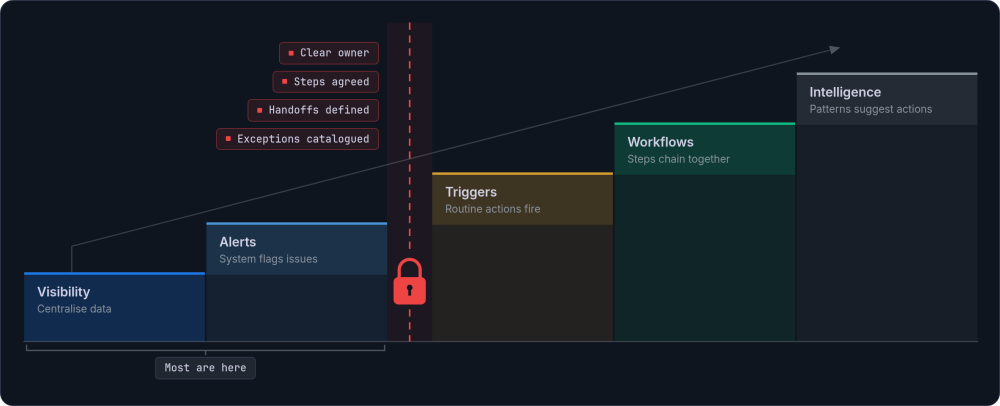
Most growing businesses operate somewhere between visibility and alerts. The immediate opportunity is usually in alerts and triggers, where relatively simple business automation eliminates a disproportionate amount of manual coordination work.
Measuring Operational Health During Growth
Revenue and headcount tell you about size, not about operational efficiency. The following metrics reveal whether your operations are keeping pace with your growth or falling behind. None of them require sophisticated tooling to measure. A spreadsheet and an honest assessment will do for a start.
Throughput ratio
Output divided by headcount. If you double your team but only increase output by 40%, your operational infrastructure is creating drag. Healthy scaling means output grows at least proportionally to headcount, and ideally faster.
How to measure it: Pick your core output unit (projects completed, orders fulfilled, clients served) and divide by total headcount each month. A service business that adds five delivery staff but still completes the same number of projects each month has a coordination problem, not a capacity problem. Plot the trend quarterly.
Time to decision
The elapsed time from identifying a problem or opportunity to making a decision about it. In well-run operations, this is hours or days. In chaotic organisations, it is weeks, because the information needed is scattered and decision-makers' attention is consumed by firefighting.
How to measure it: Track five to ten recent decisions. Note when the issue was first raised and when a decision was made. Separate the waiting time (gathering information, finding the right person) from the thinking time. In most growing businesses, 80% of the elapsed time is waiting, not thinking. That waiting time is what systems address.
First-time right rate
The percentage of work completed without rework. Aim to get this above 95%. Below 90% usually indicates systematic process problems, not individual performance issues. Rework is one of the most expensive forms of operational waste because it consumes capacity that should be producing new output.
How to measure it: For every completed piece of work over a month, note whether it required rework or correction after the first delivery. A sales-to-delivery handoff that loses scope details will generate rework on nearly every project it touches. The pattern reveals where the process is breaking, not who is underperforming.
Onboarding velocity
The time from a new hire's first day to full productivity. With documented processes, shared systems, and clear role definitions, this should be four to eight weeks. If it takes three to six months, knowledge is trapped in people's heads.
How to measure it: Ask managers when each recent hire became independently productive (handling work without regular guidance). The difference between businesses with documented processes and those without is often dramatic. A new team member who can find the process for handling a client request without asking three colleagues reaches productivity in a fraction of the time.
Founder dependency score
The percentage of operational decisions that require the founder's direct involvement. In a healthy operation at 20+ people, this should be below 10%. If the founder is involved in routine approvals, day-to-day client queries, or standard process exceptions, the business has a delegation problem and needs a deliberate plan for extracting the founder from daily operations.
How to measure it: For one week, the founder logs every decision they make and categorises it: strategic (only they can make it), operational (could be delegated with clear criteria), or routine (should be handled by a process or system). The ratio reveals how much founder capacity is consumed by work the business should be handling independently.
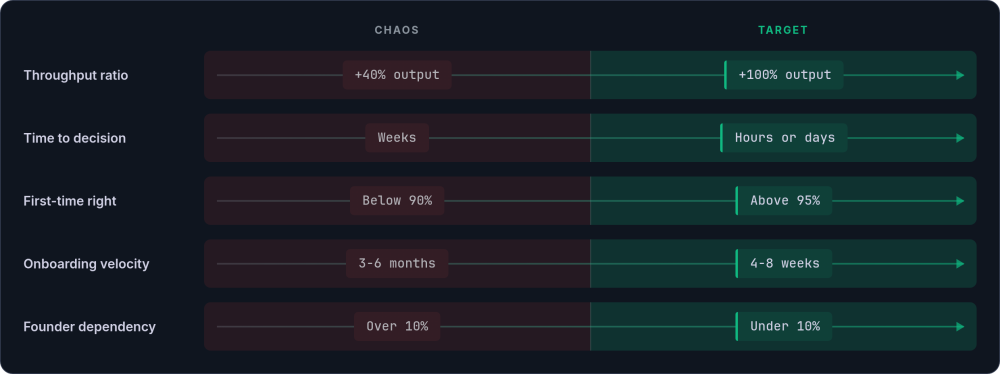
Track these monthly. The trends matter more than the absolute numbers. Improving metrics during a period of growth is the clearest signal that your operational scaling is working. Deteriorating metrics during growth is the clearest signal that your systems are not keeping pace.
Common Mistakes When Scaling Operations
Growing businesses tend to make the same operational scaling mistakes. Recognising these patterns early saves considerable time and money.
Where to Start: The Core Operational Loop
Every business has a core loop: the sequence of activities that turns an enquiry into revenue. For most service businesses, it follows a familiar path. Lead comes in, work is scoped, proposal is sent, contract is signed, work is delivered, client is invoiced, payment is collected. Start there. This is the 20% of your operations that drives 80% of your revenue, and it is where friction causes the most damage.
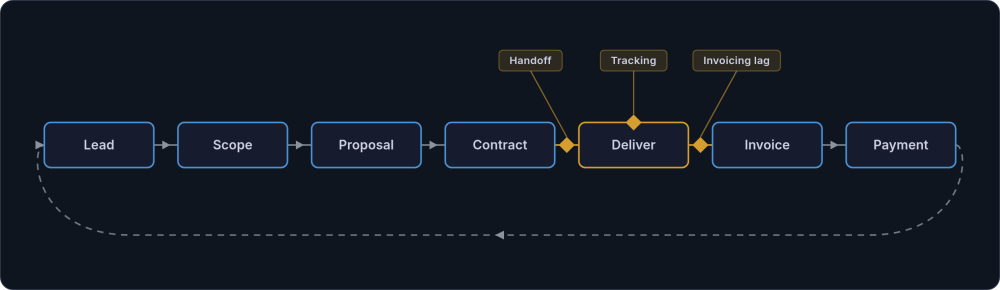
Three points in this loop consistently cause the most friction in growing businesses.
Sales-to-delivery handoff
Information gathered during the sales process does not reach the delivery team completely or accurately. Scope gets lost. Client expectations are set during sales conversations but never documented. The delivery team starts work with an incomplete picture and discovers gaps mid-project.
The fix: A structured handoff template that captures scope, expectations, constraints, and any promises made during the sales process. The handoff is a defined step with an owner, not a forwarded email.
Delivery tracking
No systematic visibility into where each piece of work stands, leading to surprises and missed deadlines. The founder or project manager becomes the status aggregator, spending hours chasing updates from the team.
The fix: A shared view of work status, updated as work progresses, so you have project visibility without chasing updates. Not a weekly status report assembled from memory, but a system that reflects reality in real time. The status update is a byproduct of doing the work, not a separate task.
Invoicing lag
Work is delivered but invoicing is delayed because the information needed (hours, deliverables, approvals) is not readily available. This creates cash flow gaps and, over time, revenue leakage as unbilled work quietly accumulates.
The fix: Connect delivery completion to invoicing as part of your financial operations. When work is marked as complete, the system assembles the invoice data automatically. The trigger is the event, not someone remembering to do it.
Each of these fixes follows the same pattern: replace a manual, memory-dependent step with a structured, system-supported one. None of them requires enterprise software. They require clear processes encoded into tools that the team actually uses. Whether you build those tools or buy them depends on how central the process is to how your business operates and how much you need the system to match your specific workflow.
What Scaling Without Chaos Looks Like in Practice
When operational scaling works, the difference is tangible. It shows up in daily working life, not just in metrics.
The business owner knows what is happening without chasing updates. Status is visible in a shared system, updated as work progresses. New hires become productive in weeks rather than months. The leadership team can take a genuine holiday. The business runs without them because it has systems that work independently of any single person.
-
Predictability Consistent process execution that does not depend on who is working on any given day. Outcomes are reliable because the process is defined, not improvised.
-
Transferability Knowledge encoded in systems rather than trapped in individuals. The business is resilient to staff changes, holidays, and illness because the knowledge lives in the system, not in someone's head.
-
Asset value A business that operates independently of its founder is a saleable asset. One that depends on them is not. Acquirers and business brokers assess operational maturity as a core factor in what a business is worth.
-
Founder independence The leadership team can step away without the business losing momentum. The business runs because it has systems, not because one person holds everything together.
-
Staff retention People spend their time on meaningful work rather than administrative friction. Clear processes reduce frustration and make roles feel purposeful rather than chaotic.
The valuation angle is worth understanding in more detail. A company where the founder is the workflow engine will sell at a lower multiple. Processes that live in one person's head, client relationships that depend on personal involvement: these make a business difficult to transfer.
Documented operations, shared systems, and predictable output push the multiple up. Michael Gerber made this point in The E-Myth Revisited: a business that depends on the founder is a job, not an asset. Every system you build isn't just an efficiency gain. It is an increase in the transferable value of what you're building.
Clients benefit too. Their experience becomes consistent regardless of which team member handles their account. Handoff quality improves. Response times stabilise. The business earns trust through reliability rather than depending on individual heroics.
The Canonical Sequence
By this point you might be thinking "right, but where do I actually start". Here is the sequence that works. Each step builds on the one before it.
Map your core loop
Identify the sequence of activities from first enquiry to cash received. Document how it actually works today, including the workarounds, the "Sarah handles that" dependencies, and the steps where information gets lost.
Assign owners and define handoff rules
Every step in the loop needs an owner. Every handoff between owners needs a defined set of information that moves with the work. Write down what "done" looks like for each step and what the next person needs to start their part.
Establish a single source of truth
Decide where each type of data lives: client records, project status, financial data, process documentation. One authoritative location per data type. Everything else is a reference, not a copy.
Instrument the bottleneck
Find the step where work queues up most often. Measure the wait time. Build visibility into it. You cannot improve what you cannot see, and the bottleneck determines the throughput of the entire loop.
Automate the stable steps
Once a step is standardised, documented, and running consistently, automate it. Start with triggers (if this happens, do that) and progress to full workflows. Automate the routine so humans can focus on the exceptions.
Extract the founder from repeatable decisions
Categorise the founder's decision load into three tiers: strategic (only they can make), operational (can be delegated with clear criteria), and routine (should be handled by the system). Progressively move decisions down the tiers. Track the founder dependency score monthly.
This is not a one-time project. It is an ongoing practice. Each pass through this sequence reduces friction, frees up capacity, and makes the next round of growth less painful than the last.
Start With Your Core Loop
If your business is somewhere between 10 and 50 people and the friction is starting to show, map your core loop. Identify the biggest handoff failure. Fix that one thing first. The rest follows. Our discovery process is designed to map exactly these operational pain points and produce a clear plan for addressing them.
Talk to us about where to start →Further Reading
Each of these sources directly supports a concept covered on this page.
- Scaling Up by Verne Harnish provides the strategic framework for stage-based growth, particularly the headcount thresholds covered in the four stages section above
- The E-Myth Revisited by Michael Gerber is the foundational text on working on your business rather than in it, and on building systems that run independently of the founder
- Traction by Gino Wickman introduces the Entrepreneurial Operating System (EOS), a practical framework for accountability, decision cadence, and standardised processes in growing businesses
- The Goal by Eliyahu Goldratt applies the Theory of Constraints to operational bottleneck thinking, directly relevant to the "optimising parts in isolation" mistake described above
- The Mythical Man-Month by Fred Brooks established Brooks's Law: adding people to a late project makes it later. The principle applies directly to hiring into broken business processes
- UK Scale-Up Institute publishes UK-specific evidence on the barriers to growth that UK SMEs face, including the coordination crisis at the 10 to 25 employee mark
